AquilaX SAST uses taint analysis and data-flow tracking, not pattern matching alone, to find exploitable vulnerabilities across 17+ languages. It runs on every pull request and pipeline and returns results in under 60 seconds.
Numbers as of Q1 2026 — updated quarterly.
Every finding ships with the exact vulnerable line, the CWE reference, and an AI explanation of the risk.
AquilaX SAST maps every finding to OWASP, CWE, and NIST identifiers so your team knows exactly what's at risk and how to fix it.
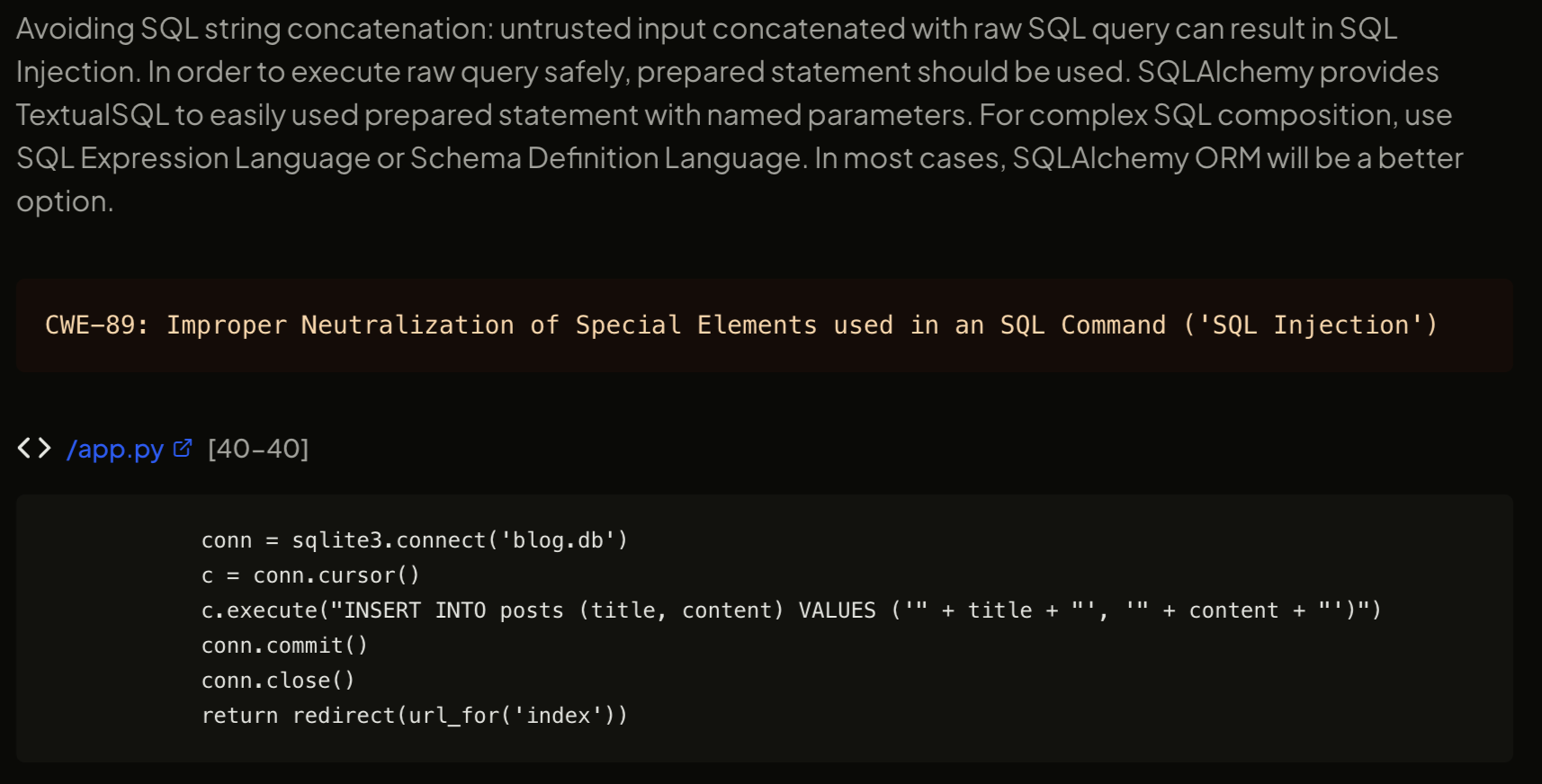
SQL injection (CWE-89), NoSQL and LDAP injection, OS command injection (CWE-78) and template injection, each traced through your codebase from the input to the dangerous call.
Reflected, stored, and DOM-based XSS (CWE-79, CWE-80). Tracks untrusted input from HTTP parameters, cookies, headers, and database values through to HTML output sinks.
Insecure session management, weak password hashing (MD5, SHA1), hard-coded credentials (CWE-798), JWT algorithm confusion, and authentication bypass patterns.
Server-Side Request Forgery (CWE-918) and path traversal (CWE-22) tracked through URL construction, file system operations, and internal service calls across your application.
Unsafe deserialization (CWE-502) in Java, Python, Ruby, PHP and .NET, one of the most common routes to remote code execution in production.
Weak ciphers (DES, RC4, MD5), ECB mode, insufficient key sizes, insecure random number generation, and improper certificate validation (CWE-295, CWE-327).
Each of these looks harmless in a diff. Here's what the code does, why an attacker can use it, and the fix AquilaX suggests.
@app.get("/users")
def get_user():
user_id = request.args.get("id")
query = f"SELECT * FROM users WHERE id = {user_id}"
return db.execute(query).fetchone()
user_id comes straight from the query string and is pasted into the SQL text. Send ?id=1 OR 1=1 and the query matches every row. Add a UNION SELECT and it reads other tables.
SAST follows user_id from request.args to db.execute and finds nothing on that path that cleans it.
user_id = request.args.get("id", type=int)
return db.execute(
"SELECT * FROM users WHERE id = %s", (user_id,)
).fetchone()
path.join doesn't stopapp.get("/download", (req, res) => {
const file = path.join(__dirname, "uploads", req.query.name);
res.sendFile(file);
});
path.join resolves ../ segments, it doesn't block them. ?name=../../etc/passwd lands outside uploads/ and Express serves it.
A lot of people believe path.join makes a path safe, and that belief is how this bug gets shipped.
const base = path.resolve(__dirname, "uploads");
const file = path.resolve(base, req.query.name);
if (!file.startsWith(base + path.sep)) return res.sendStatus(400);
res.sendFile(file);
@app.route("/cart")
def cart():
raw = request.cookies.get("cart")
items = pickle.loads(base64.b64decode(raw))
return render_template("cart.html", items=items)
The user controls the cookie, and pickle.loads runs code. An object whose __reduce__ returns os.system gives remote code execution on the very first request.
Signing the cookie helps. Moving to a data-only format removes the problem completely.
# keep the cart server-side, JSON-serialised
items = session.get("cart", [])
return render_template("cart.html", items=items)
Most SAST tools match patterns. AquilaX follows the data, so it only flags code where untrusted input can actually reach something dangerous.
From solo developers to enterprise AppSec teams. Catch issues early without slowing anyone down.
Get security feedback on every pull request instead of at the end of the sprint, and fix issues while the code is still fresh in your head.
Stop reviewing the same vulnerability classes by hand. Spend that time on architecture reviews and threat modelling instead of grep output.
Continuous SAST evidence for PCI DSS 6.3, ISO 27001 A.14, SOC 2 CC7. Auto-generate audit reports with one click from the AquilaX dashboard.
Connect your GitHub, GitLab or Bitbucket repo in 90 seconds. SAST then runs on every push.